http://www.easybib.com/auth/register/index/coupon/
If you already have an EasyBib account:
-
Log into EasyBib
-
Click on All Projects – upper left
-
Click on Coupon Codes link
-
Enter winchester2015 in box
http://www.easybib.com/auth/register/index/coupon/
If you already have an EasyBib account:
By now, the heartwarming video of Derby the dog running for the first time in his life thanks to 3D-printed prosthetic legs has officially gone viral. But Derby, a rescue dog who was born with disabled and deformed front legs, isn’t the only one excited about his fancy new limbs. While 3D printers have been used to make replacement limbs for humans, Derby is the first animal to be successfully outfitted with 3D-printed prosthetics. His ability to run marks a huge step forward for the small but remarkable field of animal prosthetics.
Derrick Campana — who helped create Derby’s new legs with designers at the 3D printing company 3D Systems — has been a trailblazer in that field for the past decade.
A certified orthotist, specializing in the creation and use of corrective braces and artificial limbs, Campana had worked only with human patients until about 10 years ago. But when a veterinarian brought a dog in need of a prosthesis to the facility where Campana was working, he discovered he could apply the same technology that he’d mastered on people to help animals. He also soon learned there was a market for animal prosthetics and orthotics that hadn’t really been tapped. So Campana founded Animal Ortho Care in Chantilly, Va., one of the first companies to make orthotics and prosthetics specifically for animals. Today, Campana told Yahoo News, Animal Ortho Care is one of five such companies in the world, seeing between 200 and 300 animal patients each month.
A few months ago, Derby became one of those patients. Tara Anderson, an employee at the South Carolina-based 3D Systems, had been fostering the disabled dog, and after a failed attempt to help him walk with a cart, she enlisted a couple of her colleagues to help make Derby some prosthetic legs. Accessing 3D printing technology was no problem, but none of them were experts in prosthetics. That’s where Campana came in.
“We were really interested in the case because we always wanted to incorporate 3D printing into our business,” he said. Though 3D printing technology has been available for a while, he explained, some of the materials and tools that work for making human prosthetics aren’t totally compatible with animals. For example, the technology used to easily scan a person’s leg is not as accurate when scanning a leg covered in fur. For Derby, Campana said he molded a fiberglass cast and scanned that into the 3D printing system.
“In the future, hopefully we can just scan the leg directly,” he said.
While 3D printing technology is bound to see furry-friendly advancements in its future, creating the perfect prosthetic is only half the battle when the patient is an animal.
“We can make a perfectly well-fitted device, but from there it takes the whole team — the veterinarian, physical therapist, the owners — to teach the dog how to use it,” Campana said.
Not every dog is a good candidate for a prosthetic. Some have been holding up their injured or missing leg for so long that retraining them to step down is very difficult.
“Derby was a hard case, but he was a good candidate because he really wanted to use his legs,” Campana said, explaining that even though he didn’t have paws, Derby still attempted to use his small forearms to get around, despite not getting very far.
“When any patient comes in here using his stump, bringing it down, that really increases the chances of success,” he said.
Campana said he’s already been in talks with 3D Systems about further collaborations. As for Derby, Campana hasn’t seen the dog since he started using his prosthetic legs, but, like nearly 3 million others, he has seen Derby’s video.
“He’s running great,” Campana said. “We’re really excited.”


A small, Indie bookstore in Winchester is one of several bookstores across the country to receive a grant from best-selling author James Patterson.
Patterson has taken $1 million of his own money to distribute as grants to hundreds of independent bookstores.
He hopes that bookstore owners will use the grants to invest in improvements, offer employees bonuses and expand literacy outreach programs, The New York Timesreported.
Patterson is the best-selling author of several fiction and nonfiction novels. About one-in-four of all hardcover suspense and thriller novels sold in 2011 were written by Patterson, according to James Patterson’s website.
Patterson has used his fortune made from his success to award grants ranging from $2,000 to $15,000 to the bookstores, according to Publishers Weekly.
Book Ends, a 2,500-square-foot bookstore, located at 559 Main Street, was in the third round of grant recipients.
Book Ends owner Judy Manzo submitted an essay to Patterson’s “ Read Kiddo Read” grant program to receive the grant.
Manzo said she is unsure of the grant amount her store received, although she requested a bonus of $10,000 in her letter to Patterson.
Patterson hopes that bookstore owners will use his grants to provide incentive to get more kids to start reading.
For Book Ends, children’s books is a large and important aspect of their store, said Manzo who is a former special education teacher.
“We sell tons of childrens books,” she said.
Between Book Ends and the book fair company Book Fairs by Book Ends, 108,000 children’s books and 21,919 adult books were sold in 2013.
“We are really passionate about getting books into the hands of children,” said Manzo.
In addition to using the money to get more kids to read, Book Ends plans to add upgraded fixtures, improve signage and lighting, add staff incentives and education, bring authors to underfunded schools, upgrade book fair racks and carts and more.

R Visions for Chinatown: Remain. Reclaim. Rebuild!
R Visions for Chinatown is a one-week series of temporary art interventions in Boston’s Chinatown highlighting public parcels or properties with potential for community development.
In response to displacement and the pressure of luxury development, the community created its own Chinatown Master Plan and is working for the goal of 1000 new or newly preserved affordable housing units, for a community-led library, a permanent facility for the Josiah Quincy Upper School, and to stabilize working class residents and small family-owned businesses. These art projects, curated and sponsored by the Wong/Yee Gallery of the Chinese Progressive Association, represent a part of the community’s efforts to reclaim public land and to rebuild a strong sense of community as Chinatown organizes for the right to remain.
R Visions for Chinatown features five projects created by nine local artists and include visual art, multi-media pieces, installations, interactive projects, as well as performances, running at different times during the week of October 19 – 25. Grab your R Visions for Chinatown Walking Guide from the Chinese Progressive Association’s Wong/Yee Gallery (One Nassau Street Unit 2, or 28 Ash Street) or just walk around Chinatown and look for these sites.
Please join the artists at a fundraising reception to benefit Right to the City Boston on Thursday, October 23, 5:30 – 7:00 pm at the Wong/Yee Gallery of the Chinese Progressive Association, One Nassau Street, Unit 2. Suggested donation $10 or more. Arrive by 6:00 pm to join us for an Art Walk!
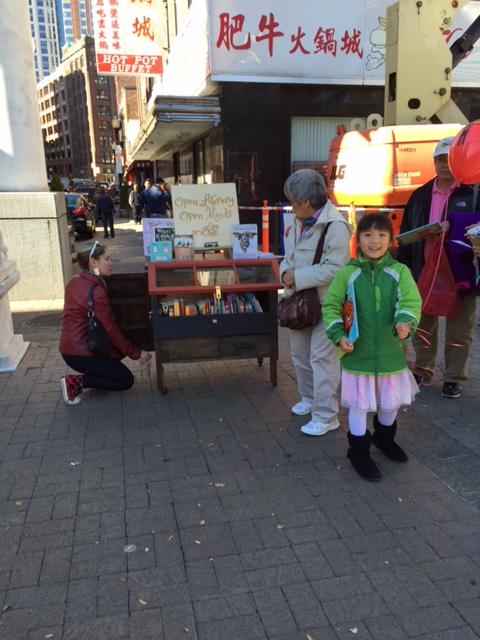
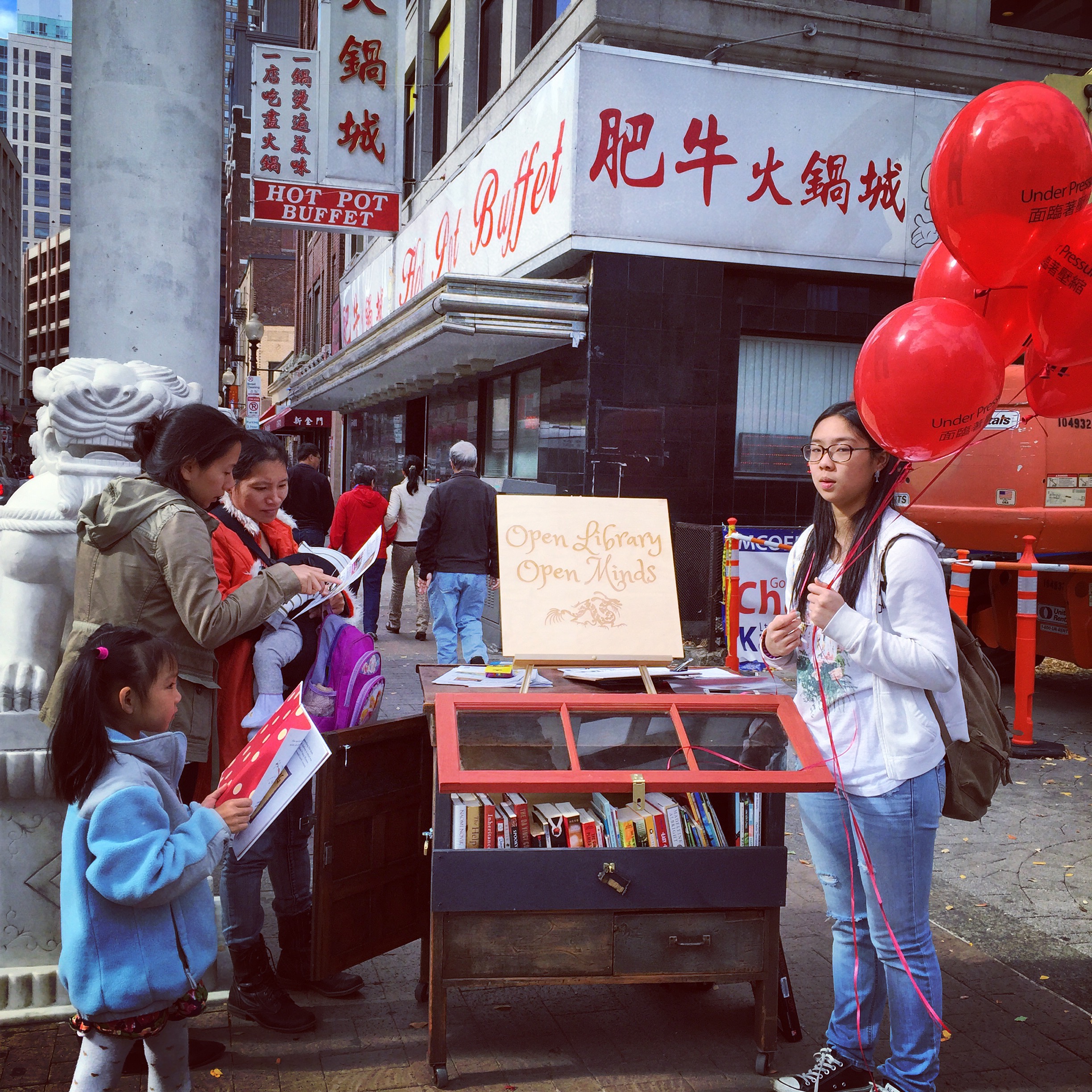
Open Library – Open Minds
Location: Chinatown Park by the Chinatown Gateway
Artists: Andrea Zampitella and Monica Mitchell
“Closed Libraries – Closed Minds” is a phrase that many protesters chanted after the closure of the Tyler St. Chinatown Library in 1956. Our library, “Open Library – Open Minds” aims to bring awareness to Chinatown visitors that Chinatown residents still do not have a library branch, as well as to provide free access to reading materials for all ages and reading levels. This mini-library will house many new books and various articles from historic newspapers on the closure of the Chinatown Library. All purchased books will be donated to the Chinatown Cultural Center and Library Project after the completion of the project.
The mini-library will be open:
Sun. 10/19, 12:00 am – 2:00 pm
Wed. 10/22, 3:30 pm – 5:30 pm
Thurs. 10/23, 5:30 – 7:30 pm
Sat. 10/25, 12:00 am – 2:00 pm

 Featuring Rick Riordan
10:45AM SATURDAY, OCTOBER 25
TRINITY SANCTUARY, 206 CLARENDON STREET
Featuring Anna Dewdney and Llama Llama
11:45AM SATURDAY, OCTOBER 25
CHARACTER CONNECTION TENT, COPLEY SQUARE
Featuring Holly Black, Soman Chainani, Cassandra Clare, and Gregory Maguire, hosted by Roger Sutton
1:00PM SATURDAY, OCTOBER 25
EMMANUEL SANCTUARY, 15 NEWBURY STREET
Featuring C. Desir, Sara Farizan, Brendan Kiely, and Stephanie Kuehn, hosted by Laura Koenig
2:00PM SATURDAY, OCTOBER 25
FIRST CHURCH SANCTUARY, BERKELEY & MARLBOROUGH STREET
Featuring Paul Durham, Laura Godwin, S. E. Grove, and Ann M. Martin, hosted by Laura Koenig
2:30PM SATURDAY, OCTOBER 25
FIRST CHURCH AUDITORIUM, BERKELEY & MARLBOROUGH STREET
Featuring Puppet Showplace Theater Resident Artist
3:00PM-5:00PM SATURDAY, OCTOBER 25
CHARACTER CONNECTION TENT, COPLEY SQUARE
Featuring Norah Dooley, Andrea Lovett, Tony Toledo, and Alan White
4:00PM SATURDAY, OCTOBER 25
FIRST CHURCH AUDITORIUM, BERKELEY & MARLBOROUGH STREET
Featuring A. S. King, Scott Westerfeld, and Meg Wolitzer, hosted by Cathryn Mercier
4:15PM SATURDAY, OCTOBER 25
EMMANUEL SANCTUARY, 15 NEWBURY STREET
Featuring William Giraldi, Ben Mezrich, and Lauren Oliver, hosted by Robin Young
11:00AM SATURDAY, OCTOBER 25
CHURCH OF THE COVENANT, 67 NEWBURY STREET
Featuring Claire Messud and Meg Wolitzer
12:30PM SATURDAY, OCTOBER 25
FIRST CHURCH SANCTUARY, BERKELEY & MARLBOROUGH STREET
Featuring Corduroy, Llama Llama, Curious George, Stellaluna, and Pete the Cat
10:00AM-3:00PM SATURDAY, OCTOBER 25
CHARACTER CONNECTION TENT, COPLEY SQUARE


Malala Yousafzai said in a televised speech Friday that the announcement that she was one of two people awarded the 2014 Nobel Peace Prize encourages her to continue her fight to empower children and women around the world. The prize was awarded to Yousafzai — who is known around the world as simply Malala — and fellow children’s rights advocate Kailash Satyarthi.
Yousafzai, a 17-year-old Pakistani schoolgirl, said in her remarks that she wants to become a politician in the future, which would see her following the path of one of her heroes, former Pakistani Prime Minister Benazir Bhutto, who was assassinated in a December 2007 bombing.
The fact that Satyarthi, a tireless advocate for the end of child slavery, is from India, while Yousafzai is from Pakistan, was a major focus of Malala’s speech. The countries have a long history of tension, and she was inspired by the fact that they were awarded the prize together to speak about the importance of the two countries “being able to have peace” in the future.
“I’m proud that I’m the first Pakistani and the first young woman or the first young person that is getting this award. It is a great honor to me…. It gives a message to people of love between Pakistan and India,” she said.
Yousafzai said that she “was not expecting that [she] would get the award” but was told by a teacher during a chemistry class Friday that she had received the prize, which she described as “an encouragement to me to go forward and to believe in myself and know that there are people standing with me in this campaign … to ensure that every child gets an education.”
In July 2013, when Yousafzai (whose name is also sometimes spelled Yousafzay or Yousufzai) was just 16, the Pakistani schoolgirl transfixed the world by delivering a moving speech at the United Nations, speaking out against the Taliban and other extremists. Her remarks came less than a year after she was shot in the head by a Taliban militant in a vicious attack on her and a group of friends.
“We call upon all governments to ensure free, compulsory education all over the world for every child,” she said in the iconic speech. “We call upon all the governments to fight against terrorism and violence to protect children from brutality and harm. We call upon the developed nations to support the expansion of education opportunities for girls in the developing world.”
The 2014 Nobel Peace Prize will be awarded to Yousafzai and Satyarthi at a ceremony in December.
“The Norwegian Nobel Committee has decided that the Nobel Peace Prize for 2014 is to be awarded to Kailash Satyarthi and Malala Yousafzai for their struggle against the suppression of children and young people and for the right of all children to education,” a statement announcing the pair as the winners reads. “Children must go to school and not be financially exploited. In the poor countries of the world, 60% of the present population is under 25 years of age.”

The 2014 Nobel Prize in Literature was awarded on Thursday to French author Patrick Modiano for “the art of memory with which he has evoked the most ungraspable human destinies and uncovered the life-world of the occupation.” Modiano, 69, is the author of more than two dozen books and several screenplays. The 11th Literature laureate born in France, Modiano is also the recipient of the Grand prix du roman de l’Académie française, the Prix Goncourt, the Prix mondial Cino Del Duca and the Austrian State Prize for European Literature. Prior to the announcement, speculation as to the next Nobel laureate in literature was rampant. Bettors at U.K. bookmakers Ladbrokes favored Kenyan poet Ngũgĩ wa Thiong’o and Japanese novelist Haruki Murakami, who had surged to the front of the pack in recent days. Murakami had frequently been fingered as a possible Nobel laureate in previous years, including in 2013, when he led the odds, only to lose out to Alice Munro. Other favorites familiar to U.S. readers included Philip Roth, Joyce Carol Oates and Thomas Pynchon — novelists celebrated by the American literary establishment but thus far without Nobel Prizes — as well as singer-songwriter Bob Dylan. Oddsmakers also favored writers less familiar to the general U.S. audience, including Svetlana Alexievich of Belarus, Austrian novelist Peter Handke, and Syrian poet Adonis. Though betting was hot and heavy at Ladbrokes, there’s little data behind Nobel odds. There’s no Nobel longlist or shortlist announced. Even the nominees are kept secret by the Nobel organization. So, how does the Nobel Prize in Literature get awarded? The Nobel Prizes are awarded by the Royal Swedish Academy, academics and thinkers who have been appointed to lifetime memberships. The Academy elects, from within its own members, The Nobel Committee for Literature, which invites distinguished academy members, previous laureates and other qualified nominators from around the world to nominate authors for the prize. From the nominations they receive, the committee selects a short list of candidates. The final choice is made by the full 18 members of the Swedish Academy, who review the life’s work of the nominees chosen by the Nobel Committee for Literature. The Nobel Prize in Literature has been the subject of considerable controversy over the years. The prize has been criticized for skipping over seminal authors such as Vladimir Nabokov, James Joyce, Virginia Woolf and Leo Tolstoy, while being bestowed upon other authors who have since languished in apparent obscurity. Some, such as Philip Roth, have suggested that the Academy relies too heavily on non-literary criteria, such as the perceived social justice value of the author’s work. In 2011, Per Wästberg, the chairman of the committee for literature, responded to this charge: “We do not have a human rights criterion,” he insisted. “We award, for example, Orhan Pamuk for his outstanding novels and essays; then the award becomes politically interpreted.” The sheer scope of the Nobel Prize presents an obvious challenge; with literature from across the globe open for consideration, it would be difficult for the Academy to recognize each highly acclaimed author from each literary tradition around the world. This breadth of consideration, as well as the relative opacity of the process, keeps critics and oddsmakers guessing each year as to what direction the Academy might take. View the full list of past Nobel laureates in Literature at Nobelprize.org

DINA RUDICK/GLOBE STAFF
An iconic statue of a lion atop the Old State House on Washington Street in Boston was hoisted down from its rooftop perch for restoration.
It’s confirmed, Boston. A time capsule has been found in the head of the lion statue that has been sitting atop the Old State House for more than a century.
Sculptor Robert Shure of Skylight Studios in Woburn, who is in charge of restoring the lion and unicorn statues from the Old State House, found the time capsule Monday, said Heather Leet, spokeswoman for the Bostonian Society. The statues were taken down Sunday for restoration.
Rumors swirled last week about the possibility of the long-forgotten time capsule, which was reported in a Globe story from 1901.
“We [the Bostonian Society] didn’t know about the Globe article until several years ago,” Leet said.
A descendant of one of the statues’ original sculptors found a letter that revealed the existence of the capsule and listed its contents. It was after the society saw the letter that it did research that turned up the 113-year-old Globe story.
RELATED: Historic statues will be restored
On Monday, Shure used a fiber optic camera to detect the capsule, which is in a sealed copper box about the size of a shoe box and secured to the sculpture with copper straps, Leet said. According to the Globe story, the capsule contains photographs, autographs, and sealed letters from politicians and prominent Bostonians of the time, along with old newspaper clippings.
Leet said Shure hopes to find a way to retrieve the time capsule with minimal damage to the lion by the end of the week. It is hoped that by next week, the Bostonian Society can have a small ceremony at the Woburn sculpture studio to extract the box.
“We’re hoping it didn’t get wet,” Leet said. An “archivist will be on hand to see the condition of the items — papers could be deteriorating, that sort of thing. . . . We don’t want the newspapers to turn to dust.”
The items found in the capsule will be added to the society’s collection and displayed this fall in the Old State House museum, Leet said. The exact dates that the capsule items will go on display depends on their condition and how long they take to process.
Before the restored statues are returned to the building, Leet said, a new time capsule will be placed inside for 22d-century Boston. Inside will be facsimiles of the 1901 contents and a photo of Mayor Martin J. Walsh, she said, but the society is asking the public for more ideas.
Ideas can be sent to the Bostonian Society via Facebook, Twitter, or e-mail, and should use the hashtag #LionAndUnicorn.
Kiera Blessing can be reached at kiera.blessing@globe.com.
 WHS Learning Commons