A Colorado Startup Resurrects Waltham Pocket Watches

A Waltham-made timepiece that Vortic Watch Company uses in their 100 percent American-made watches. (Curt Nickisch/WBUR)

 When they were undergrads at Pennsylvania State University, R.T. Custer and Tyler Wolfe had a business idea. So they pitched it at entrepreneurship competitions. Custer says all the other students were coming up with smartphone apps and web products.

“And when I walk in and pitch my physical product, all of the investors and everybody there immediately tunes out,” Custer remembers. “Because ‘Who is this guy and what is this physical product that’s 3-D printed that he’s putting in front of me?’ That was so frustrating.”

But like good entrepreneurs, Custer and Wolfe did not stop at frustrated.

They wanted to make mechanical wristwatches with all the the parts manufactured in the United States. They didn’t know it then, but that dream would lead them to resurrect Massachusetts’ manufacturing history and salvage vintage pocket watches produced for decades in Waltham. They forged ahead with their experiments at the 3-D printing lab on campus.

“We use a stainless steel 3-D printed piece that’s then infiltrated with bronze,” Wolfe says. “So we get this incredibly unique look of the molten bronze actually coming out of the pores of the stainless steel. Which is something that’s impossible to achieve using traditional manufacturing methods.”

A Waltham-made timepiece in one of Vortic Watch Company's watches. (Curt Nickisch/WBUR)

They use that cutting-edge technology with the Bronze Age-look to make the cases for their contemporary wristwatches.

“Before we started the company, we had no idea that nobody makes a 100 percent American-made watch,” Wolfe says. “So as we were looking for a timepiece to use in our watch, we were forced to look vintage.”

Vintage Boston — Waltham to be specific. From the late 19th to the middle of the 20th century, “Watch City” was home to the American Waltham Watch Company. Thousands of workers crafted millions of “scientifically-built” pocket watches, as Waltham watches were marketed back in the day, in a sprawling brick factory on the Charles River.

A postcard showing the Waltham Watch Factory circa 1930-'45. (Digital Commonwealth)

Those pocket watches since went out of fashion, ending up in attics, closets and dresser drawers. Many of their cases have been melted down for their gold and silver, leaving the mechanical watch movements intact.

“We started on eBay, just buying watches,” Wolfe says. “We bought probably 20 to 50 watches before we ever launched our company on Kickstarter. I sat in R.T.’s basement and I took apart a watch every day and tried to put it back together to find out how it works and what makes one watch better than another.”

“It’s a tiny, little engine that was built over 100 years ago,” adds Custer. “And we cleaned it, oiled it and wound it. And it worked. We don’t make things like that anymore, and we need to.”

Today, the company they founded revives those Waltham pocket watches for daily use as wristwatches — not in Watch City, but on an old farm at the edge of Fort Collins, Colorado. Outside their workshop, a sign says the name: Vortic Watch Company. Inside, ball-peen hammers and leather punchers hang next to a 3-D printer and a laser engraver.

The workshop in Fort Collins, Colorado. (Courtesy Vortic Watch Company)

“When we need a dial, we can rummage through here and see if we can find anything,” says employee Jimmy Luper as he sifts through a bag of vintage watch faces.

One dial, from 1908, is crisp, white enamel with Arabic numerals in sharp black and a recessed circle for the second hand. Another, from 1936, features Roman numerals under a golden patina of light metal scratches. Luper says both dials were made on the banks of the Charles.

“The first thing I think of is ‘What’s the history of the watch?’ ” Luper wonders. “Who wore this? Who used it? What has it been doing the last 50 years? Has it been sitting in a drawer or whatnot? And yeah, I definitely wonder, who put this together? Was it just a job, or was it their passion? I like to hope the latter.”

When Luper flips over in his hands the watch he’s working on, he can see the metal pieces engraved in cursive with “American Waltham Watch Company” and “17 Jewels.” The steel springs inside pivot on small pieces of ruby. Bigger plates are burnished with cross hatching and waves — patterns that Luper says were never visible while these mechanisms were tucked inside their metal cases.

Jimmy Luper, an employee of Vortic, works on a watch. (Curt Nickisch/WBUR)

“I absolutely love that it’s a functional piece,” Luper says. “But they said: ‘Well, why not make it beautiful? There’s no reason not to.’ And so I just think that they’re gorgeous.”

Vortic Watch Company wants to show off that scientifically-built beauty. Luper sandwiches the century-old timepiece between two pieces of Gorilla Glass, the same glass that’s on the iPhone.

Then, with a vise, he lodges the watch and glass inside the 3-D printed steel housing and adds thick leather straps. He winds it up to test the timing with an electric tool, flipping it over to watch the gears clicking away through the glass.

Last year, Vortic sold 250 of these fairly big and bold wristwatches. The customers who shell out more than $2,000 each tend to be watch fanatics, tech workers with disposable income and baby boomers.

Two watches embossed to indicate their local ties. (Courtesy Vortic Watch Company)

Steve Perlman bought two of the wristwatches. The former archaeology professor runs an inn on Martha’s Vineyard. He says many of his customers see his Vortic watch and tell him, “Wow, that’s a fascinating watch, it really looks very old!”

Perlman believes the attraction has to do with people’s complicated relationship with time.

“Some people have almost a fascination with something that is old and how it survived that long,” Perlman says. “And then to bring it to the modern world, to a time that they can associate with, I think is an interesting transference for them.”

Wolfe, the Vortic’s co-founder, says the company plans to make 500 of these wristwatches this year and another 1,000 in 2017. But eventually, he says his and Custer’s goal is to transition from custom to batch manufacturing, making and assembling all the hundreds of pieces for a watch here in the United States.

“This isn’t the end of the line for us,” Wolfe says. “We want to spread our ideas and our passion to more than just the people that can buy a $2,000 watch.”

That’s a daunting business challenge in a market dominated by Swiss manufacturers. But at 23 and 25 years old, Wolfe and Custer have got time.
Humble giant for a cherished tiny world

Mass. man’s models win wide following

Screen Shot 2015-11-23 at 9.21.32 PM.pngModelofChildhoodHomeA[1]-9564.jpg

By Cristela Guerra GLOBE STAFF NOVEMBER 23, 2015
The tiny community rises out of a dreamy haze of handcrafted 1950s suburban bliss.

It’s a small world of 1/24 scale dioramas built by a 65-year-old wistful model maker perpetually recording the past. This model town, which he calls Elgin Park, has expanded along the shelves of Michael Paul Smith’s Winchester home office for two decades. He works in silence, using an X-Acto knife to carve childhood memories out of basswood.
“I never showed [my models] to anybody from 1998 to 2008,” Smith said. “I figured ‘who was going to like this?’ It seemed odd. I collect toys like a 10-year-old. There’s a 10-year-old right below the surface.”

Smith, a self-deprecating recluse with a trim silver beard, is Elgin’s “Gulliver” and gatekeeper, its mayor and creator. He is also an international celebrity among model makers.

On the photo-sharing website Flickr, Smith has had almost 85 million views, with 13,000 followers. Comments pour in from around the world. His second book, which came out in June, is titled “Elgin Park: Visual Memories of Midcentury America at 1/24th Scale.” It’s a retrospective and behind-the-scenes look at how Elgin Park is built.

Michael Paul Smith worked in his home studio in Winchester in September.
CRAIG F. WALKER/GLOBE STAFF

Michael Paul Smith worked in his home studio in Winchester in September.

People routinely share personal anecdotes evoked by Elgin Park: about going to the record store or loading bags of salt into their trucks in winter. A doctor who treats people with Alzheimer’s disease e-mailed to let Smith know he used photos of Elgin Park with patients because the images triggered a response. A father wrote Smith and said his autistic child wouldn’t go to bed unless he got to visit Elgin Park. A young man in India wrote Smith begging to be his apprentice.

With a new piece debuted last month in Salem’s Peabody Essex Museum’s exhibit “Sizing It Up: Scale in Nature and Art,” and a short film “Elgin Park,” released in February, more visitors are discovering his tiny town. In the film, Smith compares his life to a classic black-and-white clip in the cartoon “Popeye.” Olive Oyl walks perilously over the construction site of a building wearing a blindfold.

“Every time she was about to [fall off the building], a girder came,” Smith said on camera. “That’s my life.”

He grew up outside Pittsburgh in a small town called Sewickley, near the railroad tracks. One of five kids in an Italian family, he was the shy boy. The kitchen was so small that the family had to eat dinner in shifts.

He had a rough time. At school, he was bullied and beaten up. A guidance counselor once told him “he had no discernible talent.” One teacher let him leave class 15 minutes early because she knew he was getting walloped by classmates.

His childhood wasn’t dysfunctional, Smith says. There was a lot of beauty. But some things were just not talked about. He’s battled depression most of his life. He struggled with being gay and, as a young man, attempted suicide.

“There was concern of what are people going to think, especially for someone who’s been ridiculed and bullied and through the trenches,” said Danny Yourd, 32, who directed and produced the short film. “The vulnerability he put out there engaged people to connect with him.”

And engaged they are. He once had to convince a woman that Elgin Park didn’t actually exist and that she couldn’t visit. Though Smith’s photos read like vintage snapshots, it’s a trick of the eye. To make his pictures, he arranges his small handcrafted houses and die-cast cars on a folding table, shooting the vignettes in front of real trees and buildings and other backdrops. With just the right perspective and light, the scenes appear life-size.

A model of Michael Paul Smith’s childhood home featured in his most recent book.
MICHAEL PAUL SMITH

A model of Michael Paul Smith’s childhood home featured in his most recent book.

Some fans have gone so far as to Photoshop themselves into pictures of Elgin Park. Theresa Thompson, 49, of Fort Wayne, Ind., has never met Smith in person, but they’ve dressed up in period clothing and digitally added themselves to pictures together, creating new story lines and captions to go with them.

“It’s longing for a simpler time . . . it’s the opposite of Instagram or Snapchat,” said Gail Ellison, coauthor of two books on Elgin Park and a friend of Smith’s for 30 years. “I’ve been surprised at the number of young people drawn to the work, who weren’t born in the era he’s focusing on.”

Tucker cars in a 1957 car wash.)
CRAIG F. WALKER/GLOBE STAFF

Tucker cars in a 1957 car wash.

She calls Smith meticulous. He once made a mistake while crafting a vintage milk crate at 1/24 scale in one of his dioramas. A fan informed him that type of crate didn’t fit the time period.

He apologized and fixed it.

“He’s like the postman heading out through any weather,” Ellison said. “He has it in his mind what he’s trying to convey, and he goes pulling his suitcase through the neighborhood and working endless hours.”

All of Smith’s experiences contribute to Elgin Park. He has been a wallpaper hanger and a house painter. He worked in advertising and had a heart attack at 33. When he worked as a mailman, a dog bit him on his first day. He has designed museum displays and architectural models. He got fired from a job as a bartender in Worcester because he refused to wear hot pants. He has turned down opportunities to build models for movies because they want them immediately, and he takes his time.

He is something of a hermit. Weeks can go by when the model maker doesn’t leave his house, a pumpkin-colored Victorian with a workshop on the third floor. But Smith is not alone. He has a partner of 35 years he met in a dance class.

In his studio, he passes the hours among his miniatures. On this day, Smith’s vision narrows down to 26 tiny pieces. His hands fashion a miniature Adirondack chair. As he looks up, his eyes adjust. For a moment, the world around him looks enormous.

Tucked away among his collection of memorabilia is a perfect dollhouse replica of the house he grew up in. It’s detailed down to the wallpaper, a pink pastiche of roses pulled from an old Sears catalog. It brought back good and bad memories. It brought closure.

“[W]hat I call my quirky hobby that I was afraid to show anybody is out there now,” he said. “It’s affecting people. It has changed people’s lives on some level.”

Projects in his studio included the interior of a 1927 bungalow.
CRAIG F. WALKER/GLOBE STAFF

Projects in his studio included the interior of a 1927 bungalow.

Cristela Guerra can be reached at cristela.guerra@globe.com. Follow her on Twitter @CristelaGuerra.

A SCHOOL-WIDE STUDY OF “SERIAL”

Student Abbie Fuller (left) examines larvae during a science class forensics study. Right: Lauren Boyle’s sociology class debates whether anti-Muslim prejudice impacted Syed’s conviction. Photos by Robin Brenner.

On Friday, September 11, 2015, students at Waltham (MA) Senior High School were greeted with familiar music: the opening strains of Serial, the smash-hit podcast.

Over the summer, instead of reading, the students had listened to the first season of the podcast, investigating the 1999 murder of high school student Hae Min Lee and the ensuing conviction of ex-boyfriend Adnan Syed for that crime. Friday was the day to tackle Serial from all angles, with students and teachers using writing, science, math, art, and dance to explore the case’s many questions.

In the past, school librarian Kendall Boninti and English teacher Emilie Perna used One School, One Book for the summer reading program that they cochair, and selected one title for the entire school to read. But participation varied, Boninti notes.

“We chose a nonfiction book the first year, and some students loved it and some didn’t like it at all,” she says. At the same time, an increasing number of students opted for the audiobook version. Ten percent of ninth graders listened to Ernest Cline’s Ready Player One (Random, 2011) rather than read it, Perna says. “We wanted to build on this trend.”

Planning for the 2015 summer reading assignment, teachers debated what text to choose and got around to discussing podcasts. When one teacher jokingly suggested Serial, the committee realized that the series fit all of their requirements.

While skeptics were nervous about the change in medium, the reading program committee decided that the podcast’s narrative complexity and the wealth of additional materials available would engage students. The English department director couldn’t imagine assigning anything other than a book—until he started listening to Serial. “He went down the Serial rabbit hole and read [as much related material as] he could,” Perna says. “He proved our argument that Serial could be a means to an end; the more you hear, the more you want to learn, so you turn to reading to try and find those answers.”

The committee respected some parents’ requests for an alternate title in response to concerns about Serial’s account of a murder. Other parents—already Serial fans—were excited to share it with their kids. One mom noted that this was the first time her son, who has dyslexia, could participate in the summer reading program without struggling.

In the spring, the committee made sure that students knew all the ways to listen to Serial, increasing access via donated MP3 players. Teachers taught students how to mentally process audio, encouraging them to do something else while listening, from exercising to doodling. Episode summaries, including those recorded by students; character lists; vocabulary; and time lines were available in four languages, including Spanish. Everything was made available at walthamreads.org.

Students were excited. “My sister and her friend and the rest of my family are all sitting around discussing it,” senior Victoria McGovern emailed Boninti. “Even my dad began listening to it! I can’t wait for the first week of school!”

On that September Friday, as themes from criminal dramas, including Orange Is the New Black and The Pink Panther, played between classes, teachers in each subject area presented related assignments. Student interviewers with cameras roamed the building, seeking opinions about the verdict. An Advanced Placement statistics class polled the student body on Syed’s guilt (87 percent thought Adnan should not have been convicted).

In physics, students used Google maps and distance measurements to examine whether the accused could have committed the crime within the official time line. Science teacher Matthew Burns set up a mock decomposing body, with larvae at different stages of development, inviting students to examine the insects to determine time of death. Dance teacher Deb Finnell challenged students to recall the order of fellow students in a lineup glimpsed for only seconds.

Sociology teacher Lauren Boyle challenged students to consider whether anti-Muslim prejudice had affected Syed’s conviction, asking them to think about how prejudice against Muslims has changed since September 11, 2001. Everyone took sides in a lively debate—one side arguing that anti-Muslim bias affected the verdict and the other declaring it made no difference.

Daily highlights from the project, coordinated by IT specialist Kevin Long, are on Twitter at @walthamreads.

Brenner-Robin_Contrib_WebBrookline (MA) Public Library teen librarian is editor in chief of No Flying No Tights.

Electronic Study Hall Passes

Electronic Library Passes

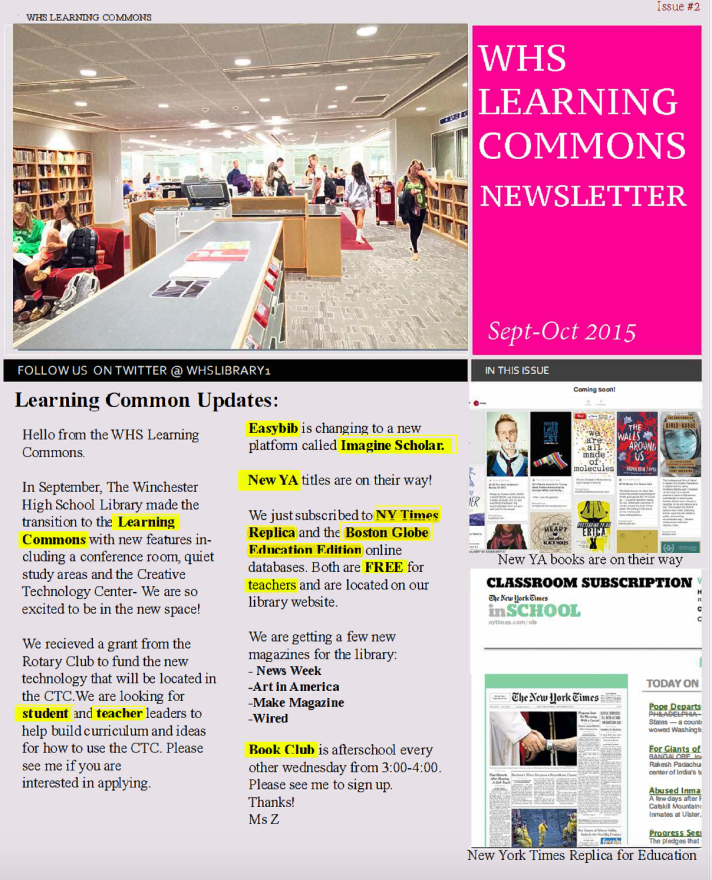
WHS is moving to electronic library passes. To get a library pass students need to go to whslearningcommons.com to sign up. The passes will be open to sign up after 8pm the night before the study hall. Students will receive a confirmation email that they will show to their study hall teachers before coming to the library.  The confirmation email should look like this:

Screen Shot 2015-11-02 at 10.43.38 AM

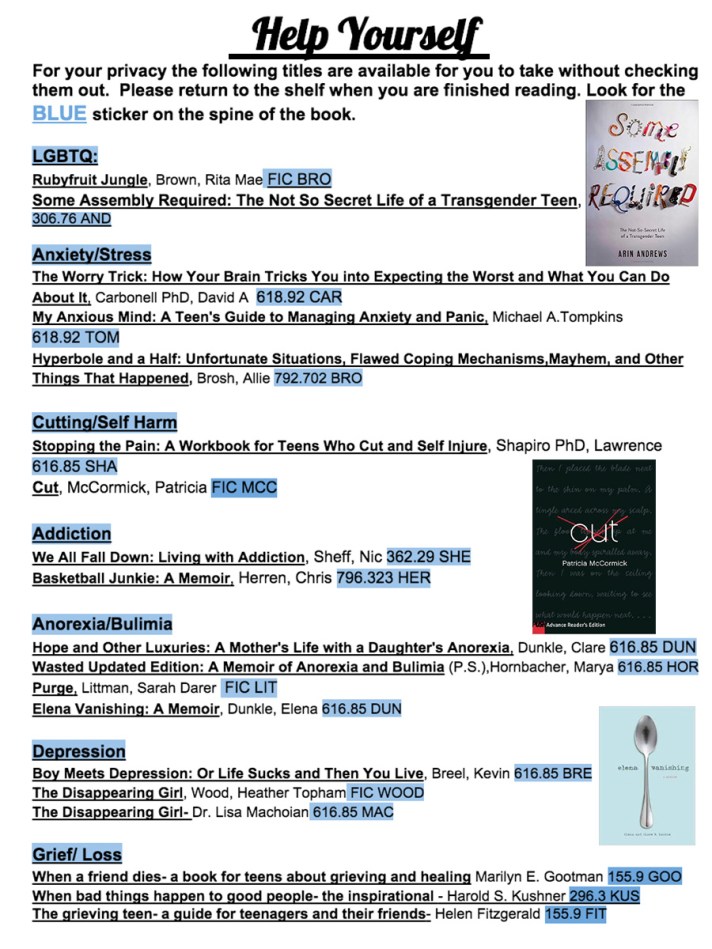
Creative Technology Center

Creative Technology Center Vision Statement:

The Winchester High School Creative Technology Center is a place in the WHS Library for students and staff to come together, share ideas and come up with creative problem-solving solutions. The room  is designed to be flexible – with mobile furniture. We envision a combination of a lab, workshop and collaborative conference space which can be utilized by students and staff from different content areas, fostering a multidisciplinary way of thinking, and learning. This student-driven, creative space is equipped with tools that will help to aid students into hands-on learning approaches. Our goal is to help students to acquire collaborative strategies, critical thinking skills, and technical competencies in order to become independent life-long learners. This space will be equipped with high end technology such as Mac workstations, HD video cameras, green screen, 3-D printers,and a sound studio with mixing boards, audio software and microphones. The Creative Technology center is research driven and encourages work at the intersection of culture, education, design and technology.